“You experience what you believe, unless you believe you won’t, in which case you don’t, which means you did.” This is from Harry Palmer of Avatar, who has an "interesting" history. Be that as it may, this is an excellent quote on positive thinking.
The underlying idea is that your beliefs create your reality. Now we have to look at 'reality' a little bit here... To borrow from ACIM, I'm going to use reality as the world we see around us, everything separate, and our eyes trusted; and Reality as a deeper truth of metaphysics - everything interrelated and requiring the perception of our intuition and feelings.
So, at the level of reality, your beliefs affect you, not the world. Even here, your beliefs change your perception of and your reaction to the world. Therefore work on your beliefs changes the world for you. Consider an example - 'I can't pay my bills'. If this is your belief, you miss possible opportunities to get out of debt. If someone presents you with an opportunity, the usual reaction is, "I can't pay my bills, how could I afford that!" Thus it has become self-fulfilling by closing your eyes to any other possibility.
At the level of Reality, we are a part of everything around us. If that is true, then we have a strong influence on the world, similar to the influence you have on getting your sister to turn on the lights for you. You ask, and she (probably) is happy to help out. Thus 'I can't pay my bills' attracts more bills to you; it tells money to stay away as this is what you're calling to. As long as you hold that belief, the world agrees. And as soon as you change that belief, the world agrees.
Which means whatever level you live at, beliefs control your reality. And you control your beliefs! By changing your beliefs, you can change your reality. Now, how do change your beliefs. Well, first you have to be aware of them. You can't change what you don't know about. Once you've found a belief, then you have to decide if it's helpful or harmful, and then decide if you want to lose it. Luckily, by looking at how you feel about your belief, you can see whether you want it or not. Notice how 'I can't pay my bills' makes you feel. How about 'everybody in this town drives crazy!' Or try 'this is a beautiful day, and I'm lucky to be here.'
As the adage goes, nature abhors a vacuum. It's nearly impossible, if not impossible, to drop a belief. It's much easier to overwrite one. That's why Affirmations are so popular. You (or a coach, partner, etc) find some belief that isn't working, turn it around into a positive affirmation, and slowly overwrite your initial belief. You can't believe that you are smart and stupid (for example) at the same time, so one will win out. Which one is up to you.
Your beliefs were given to you by trusted sources: parents, friends, teachers, life experiences. Can you be your own trusted source? Maybe, but it's harder. If your teachers told you that you were stupid, you're going to have to work hard to convince yourself otherwise. But you can. Do things you know you can do; challenge yourself a bit and see that you can do things you thought you couldn't; daily tell yourself how smart you are; have an experience proving you are smart; ask your friends to let you know when they see you do something smart. It'll take a while, and we're good at undermining our own efforts, but with work you'll do it.
Then you'll start to see the world differently - through 'smart' eyes. And you'll find all kinds of opportunities to show everyone how smart you are where you used to only see how stupid you could be. As Paulo Coelho says in his great book The Alchemist, the world wants you to succeed.
Thursday, January 29, 2009


Tuesday, January 27, 2009
More on Personal Marketing...
So I was checking out President Obama's Inauguration Speech on YouTube, and noticed all the hate going back and forth in the comments. Right at the top was this:
Then I realized what the person quoted was doing - marketing. He wanted to insult the guy, so he puts this up, knowing only a couple nerds are going to double-check him anyway. Momominnosh doesn't mean anything - the only links I found on Google were to this Momominnosh's posts. But since we (mostly) won't question it, the poster could create a connection in our minds of Momominnosh and moron. Who would question it?
So how many times a day does somebody say something that we don't check? How often does some false, misleading, or purposefully malicious thought get into our brain? I remember a lot of little details, and I really don't want 'another way to say moron is _____' in there. I'm glad I checked, as I now don't have that connection.
So how often does some false, misleading, or purposefully malicious thought get into our brain? What can we do about it? How can we go about putting some more positive ideas there?
Taking down the billboards that are the collection of beliefs in my head. I don't want to drive by them any more...
moron, or momominnosh, same thing according to WebstersSo, my curiosity piqued, I searched Google: nothing. I felt a little nerdy, looking this up, but continued. Nothing when I checked YourDictionary.com or Wikipedia either.
Then I realized what the person quoted was doing - marketing. He wanted to insult the guy, so he puts this up, knowing only a couple nerds are going to double-check him anyway. Momominnosh doesn't mean anything - the only links I found on Google were to this Momominnosh's posts. But since we (mostly) won't question it, the poster could create a connection in our minds of Momominnosh and moron. Who would question it?
So how many times a day does somebody say something that we don't check? How often does some false, misleading, or purposefully malicious thought get into our brain? I remember a lot of little details, and I really don't want 'another way to say moron is _____' in there. I'm glad I checked, as I now don't have that connection.
So how often does some false, misleading, or purposefully malicious thought get into our brain? What can we do about it? How can we go about putting some more positive ideas there?
Taking down the billboards that are the collection of beliefs in my head. I don't want to drive by them any more...
Using Personal Marketing
Lynn Brem posted a very interesting article on Get Rich Slowly, here. I commented, but think there's more to say.
The Questions
This is actually an area (advertising) we really should be looking at closely. Advertisers spend billions of dollars getting to know our brains, how they work, and how to manipulate them. Some areas of concern that every one of us should have are:
Two Questions
Which, of course, is two questions. First, where can I find the latest research on advertising and psychology? I'm sure there's some out on the internet. But I also have a feeling that the advertisers would want to keep their 'secret weapons' well, secret. I'm already finding some things like this in Predictably Irrational: The Hidden Forces That Shape Our Decisions , in what Dan Ariely calls Behavioral Economics.
The second question is in the application. Take a look around you for a moment. What does your environment do to influence you? Marketers know - this kind of advertising for that kind of show. X word has been shown to elicit 23% more of a reaction than Y word. Positive response. Negative response... Now, look around again. What does the environment you set up set you up for? How could you improve on the 'advertising' you give yourself? You actually have a huge advantage over advertisers - they have to make something that appeals to the majority without upsetting a minority; you only need to impress you.
Some Personal Advertising my family and I have done in the past:
But what could we do? Knowing ourselves, how could we make a targeted marketing campaign to one? Let's end with some suggestions, and hopefully some more in the comments section.
The Questions
This is actually an area (advertising) we really should be looking at closely. Advertisers spend billions of dollars getting to know our brains, how they work, and how to manipulate them. Some areas of concern that every one of us should have are:
- How much of an impact do 'they' have on us? Do hidden images of Pepsi make us thirsty?
- What's most effective? When are we at our most suggestible?
- What personal differences do I have? Will an ad that makes most people hungry make me sad?
- How can I use this to influence myself?
Two Questions
Which, of course, is two questions. First, where can I find the latest research on advertising and psychology? I'm sure there's some out on the internet. But I also have a feeling that the advertisers would want to keep their 'secret weapons' well, secret. I'm already finding some things like this in Predictably Irrational: The Hidden Forces That Shape Our Decisions
, in what Dan Ariely calls Behavioral Economics.The second question is in the application. Take a look around you for a moment. What does your environment do to influence you? Marketers know - this kind of advertising for that kind of show. X word has been shown to elicit 23% more of a reaction than Y word. Positive response. Negative response... Now, look around again. What does the environment you set up set you up for? How could you improve on the 'advertising' you give yourself? You actually have a huge advantage over advertisers - they have to make something that appeals to the majority without upsetting a minority; you only need to impress you.
Some Personal Advertising my family and I have done in the past:
- Put a disgusting picture on the fridge to discourage snacks.
- A family Vision and Mission Statement, to put our goals in front of us daily.
- Affirmations and Visualizations
- Put up awards, for that 'Yes, I Can' moment
- No TV in the house, to take away that easy escape. "Books are more indicative of successful people."
But what could we do? Knowing ourselves, how could we make a targeted marketing campaign to one? Let's end with some suggestions, and hopefully some more in the comments section.
- A short commercial, made by you, to you, about whatever you think you need to hear, that loads when you turn on your computer.
- A journal, or at least a couple entries, detailing some achievement you want, written in the past, on how you got it and how it felt.
- Does anybody have a theme song? I still run better when I think of the theme to Chariots of Fire.
Saturday, January 24, 2009
Should I Invest? #2: What Do You Believe?
Question #1 was about your timeframe. Question #2 is about your beliefs. To be a successful investor, you need to be cautiously optimistic. Optimistic because if you didn’t think there was a future, and a better one to spend your money in, you wouldn’t invest. Cautious because if there is any chance you could be wiped out, eventually you will be.
Investment = Sacrifice
You sacrifice something now, usually time or money, because you feel you will get something better in the future. You sacrifice living in this home, and let somebody else live there, so that you’ll have a paid-for home in the future for income or to live in. You sacrifice $1,000 of current spending money for the income it could produce, or the chance that it will be worth more in the future. This is often referred to as Return on Investment (ROI), and a 25% ROI means you’ll get back a quarter of your investment a year – and four years from now, you’ll have your original investment AND your money back out. But you must be optimistic that you will get back your money, and inflation won’t kill your profits, or why would you put off gratification?
The Meaning of Risk
If you have an investment that works 90% of the time, but has a 1% chance of costing you all of your money – you will go broke if you try it enough times. In a more normal world, if you win 55% of the time, and risk even 1/10th of your wealth, there is a 2% chance you’ll lose 5 times in a row – half your wealth! You must be cautious with your money! Warren Buffett’s famous two rules of investing are:
1. Never lose money.
2. Never forget Rule #1.
What Are Your Beliefs?
So what are your beliefs? Do you think the economy will get better or worse? What will the world look like in ten years? Twenty? Will the economy rebuild? Will businesses still be profitable? Will your life be better if you’ve doubled your money over the next ten years? Or will inflation cut money to less than half its value in that time? If you double your money, but the cost of living triples, you’re moving backwards. Take some time and think about these questions:
1. Will things get worse or better in the future? By how much?
2. Will there be inflation, deflation, or high inflation? (2-3% inflation is considered “normal”)
3. Will businesses still be profitable in the future?
4. Will your country’s economy and currency be strong in the future?
Investment = Sacrifice
You sacrifice something now, usually time or money, because you feel you will get something better in the future. You sacrifice living in this home, and let somebody else live there, so that you’ll have a paid-for home in the future for income or to live in. You sacrifice $1,000 of current spending money for the income it could produce, or the chance that it will be worth more in the future. This is often referred to as Return on Investment (ROI), and a 25% ROI means you’ll get back a quarter of your investment a year – and four years from now, you’ll have your original investment AND your money back out. But you must be optimistic that you will get back your money, and inflation won’t kill your profits, or why would you put off gratification?
The Meaning of Risk
If you have an investment that works 90% of the time, but has a 1% chance of costing you all of your money – you will go broke if you try it enough times. In a more normal world, if you win 55% of the time, and risk even 1/10th of your wealth, there is a 2% chance you’ll lose 5 times in a row – half your wealth! You must be cautious with your money! Warren Buffett’s famous two rules of investing are:
1. Never lose money.
2. Never forget Rule #1.
What Are Your Beliefs?
So what are your beliefs? Do you think the economy will get better or worse? What will the world look like in ten years? Twenty? Will the economy rebuild? Will businesses still be profitable? Will your life be better if you’ve doubled your money over the next ten years? Or will inflation cut money to less than half its value in that time? If you double your money, but the cost of living triples, you’re moving backwards. Take some time and think about these questions:
1. Will things get worse or better in the future? By how much?
2. Will there be inflation, deflation, or high inflation? (2-3% inflation is considered “normal”)
3. Will businesses still be profitable in the future?
4. Will your country’s economy and currency be strong in the future?
Friday, January 23, 2009
a Caveat
Hmmmm... Let me say something about my psychology. I'm a full-fledged Agnostic - and not just in the religious meaning of the word. The high point of Physics is Heisenberg's Uncertainty Principle which roughly states that in quantum mechanics, we can't know everything because by knowing one aspect, you change another. We can talk a lot about afterlife, but we don't have the senses to know for sure. You can statistically predict what people will do in a situation, but you can't be sure of what any one person will do... So I'm constantly learning, constantly trying new things, constantly in flux. In other words, what I post on Lucid Living is an organic R&D process. Ideas are meant to be tried on, debated, and accepted or rejected based on how they work for you - now and in the future. We're in a process of learning the truth, but have a lot of stages to go through.
What I write is part of this growing and changing process. Help me fine-tune with comments!
What I write is part of this growing and changing process. Help me fine-tune with comments!
Links of the Week
As I'm writing about investing lately, let me tell you the most important step in investing. Investing in yourself - in your education. Read, think, learn, grow. I read constantly, and look at new ideas and newsletters as much as I can. A great read, if you're thinking of investing is The Daily Wealth, by a hero of mine, Steve Sjuggerud - just don't ask me how to pronounce that! The Daily Wealth is a contrarian newsletter that looks at things a little differently. They have a lot to say, and you can learn a lot reading them.
If you want to build wealth through your work instead, give Michael Masterson's Early to Rise a read. He's built quite a few businesses to impressive proportions and has a lot to say as well.
Another favorite of mine is Van Tharp. With his background in psychology, he is a good person to listen to, on his website, through his trading game (on the website), or his book, Safe Strategies for Financial Freedom. The back of the book is on Risk management - probably the most needed part of any investor's tools. And if you have debt, savings, or your own home - you need to know about being an investor. If you understand money, you can get wealthy; if you don't you, you make other people rich. It's that simple.
Finally, to keep the YouTube tradition alive, I just found this song and have to share. I was listening to U2's Pride to celebrate MLK Day, and remembered this band. I can't believe I found a live version, with some incredible didgeridoo work.
If you want to build wealth through your work instead, give Michael Masterson's Early to Rise a read. He's built quite a few businesses to impressive proportions and has a lot to say as well.
Another favorite of mine is Van Tharp. With his background in psychology, he is a good person to listen to, on his website, through his trading game (on the website), or his book, Safe Strategies for Financial Freedom. The back of the book is on Risk management - probably the most needed part of any investor's tools. And if you have debt, savings, or your own home - you need to know about being an investor. If you understand money, you can get wealthy; if you don't you, you make other people rich. It's that simple.
Finally, to keep the YouTube tradition alive, I just found this song and have to share. I was listening to U2's Pride to celebrate MLK Day, and remembered this band. I can't believe I found a live version, with some incredible didgeridoo work.
Wednesday, January 21, 2009
Should I Invest? #1: Timeframe
This is the first of a 3-part article. With the economy in what I've heard called 'the Sandpaper stage' (back and forth, rubbing out your savings), I've talked to a lot of people about when to get in the market, or whether to get out completely and take the loss.
To me, this begs a bigger question: Should you be in 'the market' at all? To which I have three questions. The first is: What is your timeframe?
To me, this begs a bigger question: Should you be in 'the market' at all? To which I have three questions. The first is: What is your timeframe?
****************
It has been said the market is long-term a weighing machine, and short-term a popularity contest. This means that a good company, over time, will show it's fundamentals and be valued for being a good company. Unfortunately, it also means that it could take a long time to show that value, and be all over the place in the meantime. This is why most stock charts look so jagged, up and down. It's also why Blue Chips look smoother - their value has been established, so there isn't so much debate on price. See an excerpt of Warren Buffet's view on this here.
In our current economy, I would say that, to be safe, you need a time horizon of at least five years to be reasonably confident that you'll get to the 'weighing machine' part. If you will need your money in less than five years, you might not want to count on fundamentals alone to choose your investments.
Some History
Look at a graph of the S&P 500 over the since the beginning of 2000: it was at 1527 on March 20, 2000; then dropped and climbed back to 1561 on Oct 8, 2007; then fell again since then, and is now at 827. Which means if you bought an S&P 500 index fund in early 2000, you would have spent 7 1/2 years getting back to your starting point, not even a profit. Who knows how long until this latest drop comes back? Forget five years - from 2000, you're looking at ten years at the least!
Question #1
So the first question to ask yourself is, "What is my timeframe?" Think about it seriously and write down when you'll be needing that money back. Only once you know that can you think about the next step, your belief about the future.
In our current economy, I would say that, to be safe, you need a time horizon of at least five years to be reasonably confident that you'll get to the 'weighing machine' part. If you will need your money in less than five years, you might not want to count on fundamentals alone to choose your investments.
Some History
Look at a graph of the S&P 500 over the since the beginning of 2000: it was at 1527 on March 20, 2000; then dropped and climbed back to 1561 on Oct 8, 2007; then fell again since then, and is now at 827. Which means if you bought an S&P 500 index fund in early 2000, you would have spent 7 1/2 years getting back to your starting point, not even a profit. Who knows how long until this latest drop comes back? Forget five years - from 2000, you're looking at ten years at the least!
Question #1
So the first question to ask yourself is, "What is my timeframe?" Think about it seriously and write down when you'll be needing that money back. Only once you know that can you think about the next step, your belief about the future.
Monday, January 19, 2009
Thank You
I just finished reading here about a High School friend I haven't heard of since, well, High School. He wasn't a close friend (did I have those in High School?), but on hearing his name, I could instantly see his face, and that quirky fun smile. I could hear his voice. And, while I don't really remember any specific shared activity, he was definitely a good memory of school.
He just passed away last week. At the time I read about his passing, I didn't know who it was, and posted this in response:
It's interesting how my thoughts changed upon realizing who it was. I still agree with what I wrote, but it's more personal now too. In some ways, it's more true. I don't spare a lot of thought for those now gone, but for my memories of them. As he lives on in my memories, that seems the place to put attention to honor the lessons.
I have had conversations with friends, deep discussions that have opened my eyes to new ideas, changed my mind, or otherwise affected my consciousness - driving down the road alone. We don't fully experience anyone: we make up our minds about them, build up a personality for them in our mind, and occasionally actually act like we're completely on the same page. So 'Sparky' is alive and well - in the minds of hundreds or thousands of people affected by him. That's certainly where my sadness and hurt are right now.
And my joy and appreciation for having known him, and remembering the time I did have with him. Thank you for letting me know you.
He just passed away last week. At the time I read about his passing, I didn't know who it was, and posted this in response:
Wow, congratulations for having a friend like that! It sounds like he really added to the quality of your life too.
I had a good friend pass away during my first year overseas. His memorial was a marvelous experience. We spent the whole time looking back at his life, all he’d done, all he’d touched, all his friends and family. He was mid-30’s, and had lived more than most people I know.
I guess I’m saying Sparky is where he is now. The memorial is for you and the people left behind. I hope you can help make that another lesson on how to live life for his friends. Compare this life with one of ’someday I’ll go do…’. Wealth is thoughts, not things, and it sounds like he was quite wealthy. Keep your memories of him, and share that wealth.
“Those that fear death are not living life.”
It's interesting how my thoughts changed upon realizing who it was. I still agree with what I wrote, but it's more personal now too. In some ways, it's more true. I don't spare a lot of thought for those now gone, but for my memories of them. As he lives on in my memories, that seems the place to put attention to honor the lessons.
I have had conversations with friends, deep discussions that have opened my eyes to new ideas, changed my mind, or otherwise affected my consciousness - driving down the road alone. We don't fully experience anyone: we make up our minds about them, build up a personality for them in our mind, and occasionally actually act like we're completely on the same page. So 'Sparky' is alive and well - in the minds of hundreds or thousands of people affected by him. That's certainly where my sadness and hurt are right now.
And my joy and appreciation for having known him, and remembering the time I did have with him. Thank you for letting me know you.
Friday, January 16, 2009
Links of the Week
First up, a Gallup Poll says that more than half of Americans feel they are 'struggling'. I don't know - we're definitely having a harder time than two years ago as a group. But struggling? I've done some traveling, and we still have ten times the stuff most people do. Needing to cut back, sure. Thinking about slowing down a bit and paying off debt, hopefully. But the story goes Adolf Merkle killed himself because he lost half of his $9 billion recently. Still worth $5 billion, so off he goes... Let's try to have a little perspective here, okay?
Next, I'd like to show my appreciation for Heroes of Capitalism. This site has regular (every weekday it looks like) posts on the great entrepreneurs and capitalists, and what they've done for our world. Today, they give props to David Booth, the originator of the index fund. With little of the individual risk of stocks, and less of the costs of a regular mutual fund, the index fund is a base and staple of many investors' portfolios. Great site for inspiration when you need it.
Want books for cheap? Half.com is a subsidiary of eBay, with discount books, movies, and CDs available from other people like you, AND eBay's support and Paypal's convenience. Best of all, you can sell books there too, and build your eBay reputation before jumping into being a full seller there. If you manage it right, you could get your books exchanged for the price of postage.
Last week, I posted on Pandora. The one problem is that they won't broadcast to IPs outside the US. For those of you not fortunate enough to get Pandora, I've found another almost as good - Last.fm. This site also lets you enter a band, and they put together a playlist around that, so you can hear everything like Evanescence, for example. Check them out.
Finally, since I reviewed the book Loving What Is last week, I thought I'd put up a sample of Byron Katie doing 'The Work'.
Next, I'd like to show my appreciation for Heroes of Capitalism. This site has regular (every weekday it looks like) posts on the great entrepreneurs and capitalists, and what they've done for our world. Today, they give props to David Booth, the originator of the index fund. With little of the individual risk of stocks, and less of the costs of a regular mutual fund, the index fund is a base and staple of many investors' portfolios. Great site for inspiration when you need it.
Want books for cheap? Half.com is a subsidiary of eBay, with discount books, movies, and CDs available from other people like you, AND eBay's support and Paypal's convenience. Best of all, you can sell books there too, and build your eBay reputation before jumping into being a full seller there. If you manage it right, you could get your books exchanged for the price of postage.
Last week, I posted on Pandora. The one problem is that they won't broadcast to IPs outside the US. For those of you not fortunate enough to get Pandora, I've found another almost as good - Last.fm. This site also lets you enter a band, and they put together a playlist around that, so you can hear everything like Evanescence, for example. Check them out.
Finally, since I reviewed the book Loving What Is last week, I thought I'd put up a sample of Byron Katie doing 'The Work'.
Thursday, January 15, 2009
Poll Results
My first poll is over. The question was: "What are your New Year's Resolutions about?" And the results are... 2 for Financial, nothing for anything else. Two key points here:
- People are concerned about money and the economy. (duh!)
- I need more readers...
Nothing Is Average
The British TV show Human Footprint found that the average person smokes 77,000 cigarettes in their lifetime and breaks wind 15 times a day. Of course, we’ve also been told that the average family has 2.3 children. Quick poll: who here has 2.3 children, breaks wind 15 times a day, and expects to smoke 77,000 cigarettes before they’re done? The point is – none of us are average.
So I’m amazed when people put so much stock in averages. The stock market fell 34% in 2008 – not my stocks. Homes in the US fell 4% for the year ending with the third quarter, but not in California (-20.8%!) or Texas (+3.2%). And not your house, I’m betting. See statistics are a fine way to get a feel for what could happen on average, but pretty lousy in any one specific instance. So the broad markets were down 34%, but McDonald’s wasn’t (up about 12%).
Diversification is a great way to become average. The point of diversifying is to come closer to average and thus avoid as much risk as possible. One company might crash, but the average of one hundred or one thousand won’t. Probably. One home might burn down, but 20 homes in 12 states won’t. Not at the same time, at least. On the other hand, 2008 was a bad year to be average…
And basically what you’re saying is you think you’re in the bottom half, so you’d be happy to get to average. Wouldn’t it be better to beat the average? Could you do that? Sure. All it takes is a little work. Do some research. Take some time to get to know your market. Get a feel for things in general, and specifically for what you’ll be investing in. Know the best neighborhoods in your town, and buy the worst house in those neighborhoods. Find stocks now that have dropped in price, but increased in fundamentals. Stay away from bonds right now – interest rates have no way to go but up!
Next week, I’ll be writing about Should You Invest? The answer shouldn’t surprise you, but it probably will anyway. Stay tuned.
So who’s going to smoke my 77,000 cigarettes?
So I’m amazed when people put so much stock in averages. The stock market fell 34% in 2008 – not my stocks. Homes in the US fell 4% for the year ending with the third quarter, but not in California (-20.8%!) or Texas (+3.2%). And not your house, I’m betting. See statistics are a fine way to get a feel for what could happen on average, but pretty lousy in any one specific instance. So the broad markets were down 34%, but McDonald’s wasn’t (up about 12%).
Diversification is a great way to become average. The point of diversifying is to come closer to average and thus avoid as much risk as possible. One company might crash, but the average of one hundred or one thousand won’t. Probably. One home might burn down, but 20 homes in 12 states won’t. Not at the same time, at least. On the other hand, 2008 was a bad year to be average…
And basically what you’re saying is you think you’re in the bottom half, so you’d be happy to get to average. Wouldn’t it be better to beat the average? Could you do that? Sure. All it takes is a little work. Do some research. Take some time to get to know your market. Get a feel for things in general, and specifically for what you’ll be investing in. Know the best neighborhoods in your town, and buy the worst house in those neighborhoods. Find stocks now that have dropped in price, but increased in fundamentals. Stay away from bonds right now – interest rates have no way to go but up!
Next week, I’ll be writing about Should You Invest? The answer shouldn’t surprise you, but it probably will anyway. Stay tuned.
So who’s going to smoke my 77,000 cigarettes?
Wednesday, January 14, 2009
Selfishly Self-less
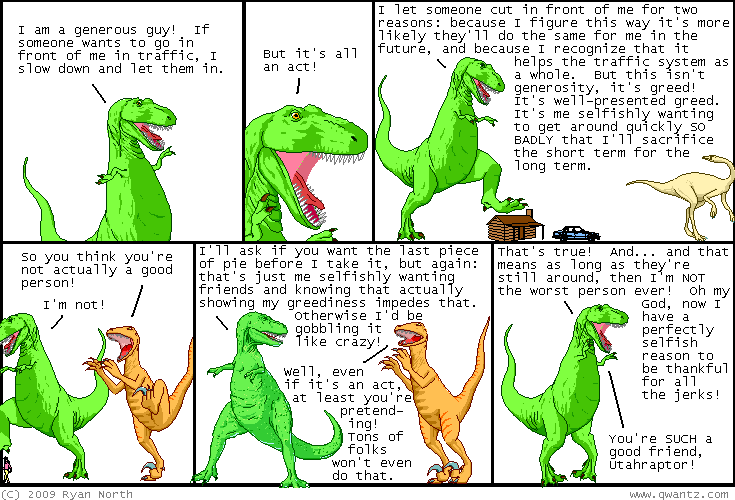
Dinosaur Comics is a personal favorite that I visit every day now. Ryan, they creator, is sharp, witty and quite wise. I find this comic particularly interesting…
I find it interesting because I think it is universally true. I don’t really believe in evil, and I think that all people are ‘hard-wired’, if you will, for good. I see it in the people around me, and I feel it myself. Here is one of the studies that show when we help people, it releases chemicals that not only make us feel better, they boost our immune system as well. The same happens for the person being helped, and random strangers that merely witness the act!
What we see as bad, or evil, is merely someone with a different viewpoint than ours. I’m sure most of the villains of our time thought they were doing good… And for some people they probably were…
Why do we open doors for strangers, let passing cars in, or help out someone in need? We are rewarded. That is true with everything we do, and some of the best rewards are positive feelings. I disagree with the comic that this is a bad thing. Everything we do, we do it because we are rewarded at some level. If we weren't rewarded, we wouldn't do it. This is a good thing.
Rewarded
Now that you know this, use it. When you're feeling down, help somebody. Allow people to help you, too. Say 'Thank you', and show appreciation to reinforce the good feelings. If you need someone's help, make sure you do your best to help them help you, and reward them with positive feedback and smiles. And make it a goal to help five people every day...
Friday, January 9, 2009
Book Review - Loving What Is
Loving What Is by Byron Katie was recommended to me when I was having a particularly stressful time around money. I’ve got to say that, while the money problem is still here, my ability to handle the stress has improved greatly – which gives me more opportunity to take control of the situation. And I really do have this book to thank to a large degree.
Byron Katie is a fantastic woman who really has a great view on reality. Basically, the crux of the book is that reality doesn’t cause our problems, it’s our expectations on reality and our reaction to reality that causes the pain. This mean our challenges are in our mind, somewhere we should be able to affect!
What Is Loving What Is?
Loving What Is is based around four simple intended to bring your thinking in line with reality, and thus remove the cause of our pain. The Four Questions are:
1. Is it true?
2. Can you absolutely know it’s true?
3. What happens when you believe that thought?
4. Who would you be without that thought?
Then comes what Byron Katie calls the turnaround – now that you understand what you thought, what is really there? It’s a chance to look more deeply into yourself, and find the source of that thought – probably another thought that would be more useful.
For example, “That idiot cut me off” is a variation of “People shouldn’t cut me off.” With the questions, it becomes:
1. Yes, of course it’s true!
2. Well, I guess not. I mean he did cut me off, so obviously at some level he SHOULD have…
3. When I believe the thought, I get mad. That doesn’t feel good. I don’t drive as safely either.
4. Without that thought, I would be still relaxed, driving safely down the road.
Now the Turnaround
People do cut me off, so what should I do? Let them! Then there’s no anger or danger, and I don’t care any more, so no negativity. Just slow down, relax, and drive safely…
It really does work – now there’s a little less negativity in your life. Next, you can apply it to family, friends, money, work expectations, and so on. Really, you’re learning how to handle when your expectations and reality don’t meet. Read Loving What Is for a lot more ideas and examples. Buy the book, so you can refer back to it, and check out the website here.
Byron Katie is a fantastic woman who really has a great view on reality. Basically, the crux of the book is that reality doesn’t cause our problems, it’s our expectations on reality and our reaction to reality that causes the pain. This mean our challenges are in our mind, somewhere we should be able to affect!
What Is Loving What Is?
Loving What Is is based around four simple intended to bring your thinking in line with reality, and thus remove the cause of our pain. The Four Questions are:
1. Is it true?
2. Can you absolutely know it’s true?
3. What happens when you believe that thought?
4. Who would you be without that thought?
Then comes what Byron Katie calls the turnaround – now that you understand what you thought, what is really there? It’s a chance to look more deeply into yourself, and find the source of that thought – probably another thought that would be more useful.
For example, “That idiot cut me off” is a variation of “People shouldn’t cut me off.” With the questions, it becomes:
1. Yes, of course it’s true!
2. Well, I guess not. I mean he did cut me off, so obviously at some level he SHOULD have…
3. When I believe the thought, I get mad. That doesn’t feel good. I don’t drive as safely either.
4. Without that thought, I would be still relaxed, driving safely down the road.
Now the Turnaround
People do cut me off, so what should I do? Let them! Then there’s no anger or danger, and I don’t care any more, so no negativity. Just slow down, relax, and drive safely…
It really does work – now there’s a little less negativity in your life. Next, you can apply it to family, friends, money, work expectations, and so on. Really, you’re learning how to handle when your expectations and reality don’t meet. Read Loving What Is for a lot more ideas and examples. Buy the book, so you can refer back to it, and check out the website here.
Links of the Week
Having lived overseas for years, where the local library's only English books were a small collection of Hemingway... I have been LOVING the local libraries again. No internet link, but a reminder of the real-world link that a library can be - free books, magazines, and newspapers, as well as literate people and a chance to meet some good people. I have the best random conversations in libraries!
If you need to buy a good book, Amazon can be cheaper than a used bookstore, and has fast delivery. I'll have a specific recommendation up tomorrow!
For a free book, from Get Rich Slowly, Suze Orman was just on Oprah, and her latest book is available for download until January 15th right here.
Working at your computer? Music always helps my productivity, and Pandora is an amazing music site. Just input a song or artist, and they'll put together a playlist based around their connections. Due to copyright, they won't work outside the US, and they don't have everything. But I've got stations based on Jason Nevins, Coming In From the Cold (Bob Marley), and Greg Brown - and most of the performers they play I've never heard of before. Just don't let it distract you too much at work!
And finally, a new project I'm starting: Online Money Journal. This will be a blog of my attempts to make money online. If you're thinking of doing the same, come share the journey with me. I'll be looking at blogging, affiliation, selling, eBay, and telecommuting through some very good online sites. Help me (help you?) create wealth online!
If you need to buy a good book, Amazon can be cheaper than a used bookstore, and has fast delivery. I'll have a specific recommendation up tomorrow!
For a free book, from Get Rich Slowly, Suze Orman was just on Oprah, and her latest book is available for download until January 15th right here.
Working at your computer? Music always helps my productivity, and Pandora is an amazing music site. Just input a song or artist, and they'll put together a playlist based around their connections. Due to copyright, they won't work outside the US, and they don't have everything. But I've got stations based on Jason Nevins, Coming In From the Cold (Bob Marley), and Greg Brown - and most of the performers they play I've never heard of before. Just don't let it distract you too much at work!
And finally, a new project I'm starting: Online Money Journal. This will be a blog of my attempts to make money online. If you're thinking of doing the same, come share the journey with me. I'll be looking at blogging, affiliation, selling, eBay, and telecommuting through some very good online sites. Help me (help you?) create wealth online!
Thursday, January 8, 2009
Living Well Rule #1: Know Yourself
It was really interesting. I had just gotten back from a trip through Greece and Turkey, and was looking over my pictures. I had picture after picture of the Blue Mosque, the palace in Istanbul, Bosphorus Strait, and the Parthenon. And here was one picture of me on a beach in Mykonos, a Greek Isle in the Aegean Sea.
I wondered why I had so many pictures of building, ruins, and famous places – and yet only one of this gorgeous beach. Had I forgotten to take pictures here? Obviously I had. And yet why?
It came to me slowly, through several conversations with friends over the next week. The other places were beautiful, and everyone was taking pictures of them, so I went along with the crowd. Not overly interested, I walked, half-bored, taking pictures of buildings that drew so many people year after year.

But the beaches and natural beauty of the Aegean Sea was breathtaking. I’ve realized that I’m a lover of the natural, the eternal. Man-made objects, no matter how spectacular, historic, and famous, just don’t have the same pull. Give me white, sandy beaches with a few tropical trees and I’m in heaven. A sunset over the sea, SCUBA diving amongst coral beds, or hiking to a distant waterfall – these are the things I want to experience.
And this knowledge of myself has been very good for the pocketbook. I have little interest in big, expensive touristy areas. Disneyland, or the Great Wall, or any famous building - I don't need to spend my money there.
I live at the beach, in a small town - and have all the natural beauty and free vacations I can handle. When I'm stressed out, I just grab my camera and watch the sun set. I go for walks on the beach with my family, or sit next to a stream.
So take the time to get to know yourself, and save yourself time and money most people spend chasing things they don't really want.
I wondered why I had so many pictures of building, ruins, and famous places – and yet only one of this gorgeous beach. Had I forgotten to take pictures here? Obviously I had. And yet why?
It came to me slowly, through several conversations with friends over the next week. The other places were beautiful, and everyone was taking pictures of them, so I went along with the crowd. Not overly interested, I walked, half-bored, taking pictures of buildings that drew so many people year after year.

But the beaches and natural beauty of the Aegean Sea was breathtaking. I’ve realized that I’m a lover of the natural, the eternal. Man-made objects, no matter how spectacular, historic, and famous, just don’t have the same pull. Give me white, sandy beaches with a few tropical trees and I’m in heaven. A sunset over the sea, SCUBA diving amongst coral beds, or hiking to a distant waterfall – these are the things I want to experience.
And this knowledge of myself has been very good for the pocketbook. I have little interest in big, expensive touristy areas. Disneyland, or the Great Wall, or any famous building - I don't need to spend my money there.
I live at the beach, in a small town - and have all the natural beauty and free vacations I can handle. When I'm stressed out, I just grab my camera and watch the sun set. I go for walks on the beach with my family, or sit next to a stream.
So take the time to get to know yourself, and save yourself time and money most people spend chasing things they don't really want.
Wednesday, January 7, 2009
No News Is Good News - Your Mental Health Is Too Important to Read Bad News
Yahoo’s featured articles this morning when I got online the other day were:
1. Israel Air Strike – Over 200 Dead
2. Hawaii’s Oahu Island Has Massive Blackout
3. 9th Body Found in Shooting
Wow, and I can only imagine what the TV news was like. There was a fourth article about killing, but I can’t find it again. So that’s three articles about killing, and one only about a major inconvenience…
I don’t read any of these articles, of course. My mental health is too important to spend it on reading bad news. I’ll hear enough with headlines and in casual conversation over the day. But I write, and I invest, and I take care of my four-year-old. Why would I want to fill my mind with negative press? I’ve often read in the paper calls for more positive news, but that isn’t going to happen as long as we keep buying, and supporting their doom and gloom.
So I do something about it: no more reading articles online, no more watching the news on TV, no more buying newspapers – until they start writing things I want to read. Frankly, I don’t expect it to happen, so I’m just going to avoid the majority of the news for the foreseeable future.
Trust me, there’s still enough out there. I’ll still be getting most of the news. At least the big national and international, and the newsworthy local content. But I’m not going to fixate on the negative, spend much time on it, or look at it in a way that shows the media that they can make money off of it. Since the majority of their income comes from advertising, and that comes from subscription/hits/ratings, I will stay off their radar. I won’t buy a paper, click through a link, or turn on the news. One less reader, one less person their advertisers will reach…
Given the recent economic news, this is doubly true. Successful investors must be ‘cautiously optimistic’. If I’m not optimistic, why would I invest at all? There must be a positive future out there to be saving for. But overly optimistic leads to overly risky, so a certain level of caution must be kept – no irrational exuberance here! And news, with its drama and sensationalism, is anathema to cautious optimism.
My mental health is too important to read bad news. Instead of expecting the media to be concerned with my intake, I take it upon myself to monitor content. If you feel the same way, take responsibility to manage the amount of negative news you get. You can:
1. Get rid of your TV, or at least don’t watch news.
2. Don’t subscribe to any newspaper that doesn’t feed you the diet of news you want.
3. Get the headlines, but don’t click through links that aren’t for the type of content that stimulates you.
1. Israel Air Strike – Over 200 Dead
2. Hawaii’s Oahu Island Has Massive Blackout
3. 9th Body Found in Shooting
Wow, and I can only imagine what the TV news was like. There was a fourth article about killing, but I can’t find it again. So that’s three articles about killing, and one only about a major inconvenience…
I don’t read any of these articles, of course. My mental health is too important to spend it on reading bad news. I’ll hear enough with headlines and in casual conversation over the day. But I write, and I invest, and I take care of my four-year-old. Why would I want to fill my mind with negative press? I’ve often read in the paper calls for more positive news, but that isn’t going to happen as long as we keep buying, and supporting their doom and gloom.
So I do something about it: no more reading articles online, no more watching the news on TV, no more buying newspapers – until they start writing things I want to read. Frankly, I don’t expect it to happen, so I’m just going to avoid the majority of the news for the foreseeable future.
Trust me, there’s still enough out there. I’ll still be getting most of the news. At least the big national and international, and the newsworthy local content. But I’m not going to fixate on the negative, spend much time on it, or look at it in a way that shows the media that they can make money off of it. Since the majority of their income comes from advertising, and that comes from subscription/hits/ratings, I will stay off their radar. I won’t buy a paper, click through a link, or turn on the news. One less reader, one less person their advertisers will reach…
Given the recent economic news, this is doubly true. Successful investors must be ‘cautiously optimistic’. If I’m not optimistic, why would I invest at all? There must be a positive future out there to be saving for. But overly optimistic leads to overly risky, so a certain level of caution must be kept – no irrational exuberance here! And news, with its drama and sensationalism, is anathema to cautious optimism.
My mental health is too important to read bad news. Instead of expecting the media to be concerned with my intake, I take it upon myself to monitor content. If you feel the same way, take responsibility to manage the amount of negative news you get. You can:
1. Get rid of your TV, or at least don’t watch news.
2. Don’t subscribe to any newspaper that doesn’t feed you the diet of news you want.
3. Get the headlines, but don’t click through links that aren’t for the type of content that stimulates you.
Living With(out) Trolls
And - I'm off the first page! The last post was my 9th, putting my 7-posts-per-page Blog officially onto page 2!
To celebrate, I'm echoing a post from another Blog - J.D. at Get Rich Slowly has a great article about Facing and Fighting Financial Trolls that is excellent and needs to be brought up again. And again.
Too many people have a negative attitude, and are full of reasons why they (or you) can't do it. If you listen to 'them', you'll never get where you want to go... So read the article and work to get rid of the Trolls in your life. As Abraham says, "Look around less and imagine more" until you see the reality you want.
To celebrate, I'm echoing a post from another Blog - J.D. at Get Rich Slowly has a great article about Facing and Fighting Financial Trolls that is excellent and needs to be brought up again. And again.
Too many people have a negative attitude, and are full of reasons why they (or you) can't do it. If you listen to 'them', you'll never get where you want to go... So read the article and work to get rid of the Trolls in your life. As Abraham says, "Look around less and imagine more" until you see the reality you want.
What’s Your Path? – a Gamer’s Perspective on Personal Development
In Dungeons and Dragons, you build a character to represent you in the game world; think of a character in your favorite book, and now imagine that you make the decisions for him in an interactive story. Normally, these characters can attain up to level 20 – the ultimate in the character’s development. And there are online sites devoted to building these ‘people’ to be the best they can, over a range of 20 levels. You see, if you choose wrongly at lower levels, it can impede or block later decisions, and limit your character’s potential. So you start at 20, and ‘reverse engineer’ your character.
Which got me thinking… Why don’t I do this personally? If I looked at myself ‘fully developed’, what would I like to look like, and how would I have gotten there? It was amazing to think about, and I’d recommend everyone try it. Start thinking like this:
• Describe your ideal self. Rich? In shape? Family? Job? No job? Where do you live?
• What skills would you need to have to get there?
• What experiences?
• What situations would you have had to get that experience?
• What things do you have? How did you get them?
When you’re done, you should have a pretty full sheet. I’d suggest separate paths for job/money, skills/job, situations/experiences, and people encountered or things. Work out a rough timeline of either cause and effect, or ‘by the time I’m 30 I will have…’ Put it in chronological order, and reverse engineer your path. Look at the timeframe – is it realistic? What do you have to achieve first? What do you have to do next? What do you have to be doing RIGHT NOW?
For example, once you’ve decided you want to own your own restaurant (for example), what do you have to do? You’ll need lots of experience as a manager, money to buy in, and a great location & menu. If you see your two children helping in the restaurant, it’s time to start thinking about that too. So get a job in management, or as a host, waiter, or even busboy to get started. Build up your experience and responsibility, and save all you can. Learn systems, and play out in your head when and how you will start your restaurant. Will you buy it from your boss? Start your own from scratch? Will a partner bring the opportunity to you?
The more you decide ahead of time, the more likely it will all come true. Once you know what you need, you’ll see every event in terms of your needs, and respond with your needs and plans in mind. If you envision living in a tropical climate, you’ll start looking for jobs there, talking to people who go there, and paying attention to possibilities to get there. Your friends and acquaintances will have heard what you want, and every time that place comes up, they’ll think of you.
You might not end up exactly where you want, but you’ll be a lot closer than if you don’t know. As Yogi Berra famously said, “If you don’t know where you’re going, you’ll wind up somewhere else.”
Which got me thinking… Why don’t I do this personally? If I looked at myself ‘fully developed’, what would I like to look like, and how would I have gotten there? It was amazing to think about, and I’d recommend everyone try it. Start thinking like this:
• Describe your ideal self. Rich? In shape? Family? Job? No job? Where do you live?
• What skills would you need to have to get there?
• What experiences?
• What situations would you have had to get that experience?
• What things do you have? How did you get them?
When you’re done, you should have a pretty full sheet. I’d suggest separate paths for job/money, skills/job, situations/experiences, and people encountered or things. Work out a rough timeline of either cause and effect, or ‘by the time I’m 30 I will have…’ Put it in chronological order, and reverse engineer your path. Look at the timeframe – is it realistic? What do you have to achieve first? What do you have to do next? What do you have to be doing RIGHT NOW?
For example, once you’ve decided you want to own your own restaurant (for example), what do you have to do? You’ll need lots of experience as a manager, money to buy in, and a great location & menu. If you see your two children helping in the restaurant, it’s time to start thinking about that too. So get a job in management, or as a host, waiter, or even busboy to get started. Build up your experience and responsibility, and save all you can. Learn systems, and play out in your head when and how you will start your restaurant. Will you buy it from your boss? Start your own from scratch? Will a partner bring the opportunity to you?
The more you decide ahead of time, the more likely it will all come true. Once you know what you need, you’ll see every event in terms of your needs, and respond with your needs and plans in mind. If you envision living in a tropical climate, you’ll start looking for jobs there, talking to people who go there, and paying attention to possibilities to get there. Your friends and acquaintances will have heard what you want, and every time that place comes up, they’ll think of you.
You might not end up exactly where you want, but you’ll be a lot closer than if you don’t know. As Yogi Berra famously said, “If you don’t know where you’re going, you’ll wind up somewhere else.”
Monday, January 5, 2009
Vilfredo Pareto, and the Law of the Vital Few
Vilfredo Pareto was an Italian economist living in the early part of the 20th century. He made the first observation that has come to be known as the Pareto Principle, the 80 / 20 rule, or the Law of the Vital Few. In its earliest form, it said, “You know, 80% of the land in Italy belongs to 20% of the people.”
Now it has been applied to many areas, and is considered a universal economic principle:
1. 20% of customers account for 80% of sales volume
2. 20% of customers account for 80% of profits (not necessarily the same customers!)
3. 20% of the people own 80% of the wealth
4. 20% of cars produce 80% of the pollution
5. 20% of sales campaigns produce 80% of the results
6. 20% of errors produce 80% of complaints
7. 20% of your work produces 80% of your results
The second to last point is interesting if you work in sales, service, or manufacturing – and that’s most of us, isn’t it? It means that if you can determine which small part of your job causes most of the problems, you can streamline yourself greatly with a minimal amount of effort. By fixing 1/5 of your “challenges”, you fix 4/5 of your losses. Now that’s leveraging your time! And, once you’re there, it means there’s not much point to working on the other 80%.
And the last one is the big one. As we’ve just started a new year, you’re probably looking at several areas you plan to improve. You have resolutions and goals that you’d like to meet in the coming year. But what if you could pare down your goals to a few steps most likely to get you where you want to be?
80/20 and You
Let’s start with a pretty easy application – your To Do list. Take it out, and look it over and pick out the 1 in 5 things that will give you the biggest returns. Focus on those, and forget the rest. I know this seems extreme, but it works. Once you have your top 20% done, you can re-work your list and get into the next part, or maybe new things will come to the top of your list.
Keep in mind this is a rule of thumb. It won’t always work out – maybe you have eight things on your To Do list. Or you see that 40% of you work creates most of your productivity. You will have to determine how it fits in your life. Here is an example on how to apply it to your finances. The principle is critical though: a minority of your efforts create most of your results. This demonstrates leverage and inverse leverage – you don’t want to spend half your time getting 10% results!
So make this a core philosophy, and streamline your life. A little efficiency at the right place can make a huge difference!
Now it has been applied to many areas, and is considered a universal economic principle:
1. 20% of customers account for 80% of sales volume
2. 20% of customers account for 80% of profits (not necessarily the same customers!)
3. 20% of the people own 80% of the wealth
4. 20% of cars produce 80% of the pollution
5. 20% of sales campaigns produce 80% of the results
6. 20% of errors produce 80% of complaints
7. 20% of your work produces 80% of your results
The second to last point is interesting if you work in sales, service, or manufacturing – and that’s most of us, isn’t it? It means that if you can determine which small part of your job causes most of the problems, you can streamline yourself greatly with a minimal amount of effort. By fixing 1/5 of your “challenges”, you fix 4/5 of your losses. Now that’s leveraging your time! And, once you’re there, it means there’s not much point to working on the other 80%.
And the last one is the big one. As we’ve just started a new year, you’re probably looking at several areas you plan to improve. You have resolutions and goals that you’d like to meet in the coming year. But what if you could pare down your goals to a few steps most likely to get you where you want to be?
80/20 and You
Let’s start with a pretty easy application – your To Do list. Take it out, and look it over and pick out the 1 in 5 things that will give you the biggest returns. Focus on those, and forget the rest. I know this seems extreme, but it works. Once you have your top 20% done, you can re-work your list and get into the next part, or maybe new things will come to the top of your list.
Keep in mind this is a rule of thumb. It won’t always work out – maybe you have eight things on your To Do list. Or you see that 40% of you work creates most of your productivity. You will have to determine how it fits in your life. Here is an example on how to apply it to your finances. The principle is critical though: a minority of your efforts create most of your results. This demonstrates leverage and inverse leverage – you don’t want to spend half your time getting 10% results!
So make this a core philosophy, and streamline your life. A little efficiency at the right place can make a huge difference!
Sunday, January 4, 2009
Desire and Discipline – What Motivates You and Gets You Out the Door?
I’m going to start with a story from Trading in the Zone by Mark Douglas. He talks about when he decided to take up running again, and how hard it was at first. Often, he’d let the TV or the weather keep him from his run. He wanted to be a runner again, and found he needed to discipline himself very strictly to keep running. He would set goals, and make himself go out daily to reach them. By the end of the summer, he had reached a big goal and was worried that he’d let down without new motivation. But a funny thing happened: he got up the next day, goal-less, and ran anyway…
It seems we have two main motivators: the carrot and the stick; greed and fear; desire and discipline. Call it what you will – you are either led or pushed.
What Mark Douglas talks about is moving from discipline – and pushing himself out the door each day – to desire. He then believed himself to be a runner, so he did what runners do: run. He didn’t need to push himself, so did it more often and with a more positive outlook in the process. In What’s Your Why?, I looked at building a future desire that would pull you forward. Once you know what you want, and you believe you deserve it, things become much easier.
What Motivates You?
So take the time to look at your motivators. Both desire and discipline will get you where you want to go, but one will be much more enjoyable. Let’s imagine two businessmen – one is worried about the economy and his financial security, and the other is excited about his new business idea and the possibilities success will open up to him. Which will make more money? Which would you rather be? Who will get up in the morning, happy to get started on the day? Who will talk about his business more, and find more possible ways of success?
How about you? Where are you?
1. Are you happy to get up each day, or do you have to push yourself?
2. Do your goals or resolutions excite you?
3. Would you like to continue to do what you do if you weren’t paid for it?
What Is Your Desire?
Discipline can be a great way to get started. But your passion, your energy, your creativity – comes from desire and doing what you love. If you’re already there, great. But if not, how can you make the move from ‘doing what you have to’ to ‘loving what you do’? Maybe you’ll have to look for a new circumstance in your life. But maybe you’ll find a way to love what you do, love the process, or just take pride in doing your job well. What is your desire, and how can you harness it?
It seems we have two main motivators: the carrot and the stick; greed and fear; desire and discipline. Call it what you will – you are either led or pushed.
What Mark Douglas talks about is moving from discipline – and pushing himself out the door each day – to desire. He then believed himself to be a runner, so he did what runners do: run. He didn’t need to push himself, so did it more often and with a more positive outlook in the process. In What’s Your Why?, I looked at building a future desire that would pull you forward. Once you know what you want, and you believe you deserve it, things become much easier.
What Motivates You?
So take the time to look at your motivators. Both desire and discipline will get you where you want to go, but one will be much more enjoyable. Let’s imagine two businessmen – one is worried about the economy and his financial security, and the other is excited about his new business idea and the possibilities success will open up to him. Which will make more money? Which would you rather be? Who will get up in the morning, happy to get started on the day? Who will talk about his business more, and find more possible ways of success?
How about you? Where are you?
1. Are you happy to get up each day, or do you have to push yourself?
2. Do your goals or resolutions excite you?
3. Would you like to continue to do what you do if you weren’t paid for it?
What Is Your Desire?
Discipline can be a great way to get started. But your passion, your energy, your creativity – comes from desire and doing what you love. If you’re already there, great. But if not, how can you make the move from ‘doing what you have to’ to ‘loving what you do’? Maybe you’ll have to look for a new circumstance in your life. But maybe you’ll find a way to love what you do, love the process, or just take pride in doing your job well. What is your desire, and how can you harness it?
Friday, January 2, 2009
Book Review - Paradox of Choice
It has been said that sometimes the fastest way to enjoy a book is to not read it. You look at the introduction, the table of contents, maybe read an interesting section or two and move on to your next book…
That’s exactly what I did with Paradox of Choice – Why More Is Less by Barry Schwarz. Don’t get me wrong, it’s an interesting premise. It’s just not really new to me. The book is divided into four parts: When We Choose; How We Choose; Why We Suffer; and What We Can Do. The first three were pretty obvious, and further backed up by comments in the final section. And I had already had the first three sections summed up by reading I’m a Stranger Here Myself by Bill Bryson and Trading in the Zone by Mark Douglas.
Part four confirmed my thoughts about the first three sections – and I do agree that we have too many choices in the US. And it certainly seems logical that it becomes harder to make a decision, leading to analysis paralysis, and then to buyer’s remorse when you hear someone else’s tale. So I didn’t need to be convinced, and What We Can Do was the section that really interested me.
So I was rather disappointed with what I found here. He puts forth 11 steps to lessen or cut out the suffering that too much choice can create, and I found most of them almost as negative as the problem and/or not going far enough. Let me write them in a somewhat less positive light than he did, then again in a more Aware manner afterwards:
1. Make it a rule to ignore most choices out there, as those choice probably aren’t much better than the ones you’ve already looked at. Probably…
2. Don’t limit yourself to the choices presented. Think outside the box if none of the current choices look that good. And they won’t since you’re ignoring most of them…
3. Learn to accept “good enough”.
4. Don’t try new things. Stick to what is “good enough” until enough friends tell you what you’ve been missing.
5. Don’t be willing to admit you could have chosen better.
6. Be grateful for what you have.
7. Don’t regret or relive past decisions. ( But what about, “Those who ignore the past are destined to repeat it.”)
8. Realize that your satisfaction will drop, so be ready for it.
9. Don’t expect too much.
10. Don’t talk to friends about their experiences – you’ll probably feel worse.
11. Learn to love constraints.
Ugh! Now, I worded those in a more negative way than he did, but that’s really his list, paraphrased! Is this really the best we can do? What about ‘Try all we can while we’re young, and learn what we like so we can be more discriminatory later’? Or, as promised, a more conscious, Aware list:
1. When choosing, follow your heart. If one choice seems superior, let that feeling guide you. (Perhaps test this for a while to develop your ability to sense your intuition.)
2. If no choice feels right, look for a deeper reason – either you will have to create your own choice, or you should not choose any!
3. Be satisfied with your choice. Allow it to be the best for you (in terms of value, cost, and time saved from agonizing over choices).
4. Practice an attitude of gratitude in all things – possessions, friends, your environment, etc.
5. Realize your wanting mind will create dissatisfaction. Know that this dissatisfaction exists only in your mind, and will not change based on your possessions.
6. Be delighted in your friends’ fortunes, not jealous. Share in their happiness, and you now have the happy experience without the expense!
To wrap up, the concept and lessons of the book are sound. I would definitely recommend a good skim at least. The book is certainly worthwhile for introducing its concept and putting together a new overall idea. But I have read most of the message before, and I think Barry Schwarz doesn’t go deep enough with his solution.
That’s exactly what I did with Paradox of Choice – Why More Is Less by Barry Schwarz. Don’t get me wrong, it’s an interesting premise. It’s just not really new to me. The book is divided into four parts: When We Choose; How We Choose; Why We Suffer; and What We Can Do. The first three were pretty obvious, and further backed up by comments in the final section. And I had already had the first three sections summed up by reading I’m a Stranger Here Myself by Bill Bryson and Trading in the Zone by Mark Douglas.
Part four confirmed my thoughts about the first three sections – and I do agree that we have too many choices in the US. And it certainly seems logical that it becomes harder to make a decision, leading to analysis paralysis, and then to buyer’s remorse when you hear someone else’s tale. So I didn’t need to be convinced, and What We Can Do was the section that really interested me.
So I was rather disappointed with what I found here. He puts forth 11 steps to lessen or cut out the suffering that too much choice can create, and I found most of them almost as negative as the problem and/or not going far enough. Let me write them in a somewhat less positive light than he did, then again in a more Aware manner afterwards:
1. Make it a rule to ignore most choices out there, as those choice probably aren’t much better than the ones you’ve already looked at. Probably…
2. Don’t limit yourself to the choices presented. Think outside the box if none of the current choices look that good. And they won’t since you’re ignoring most of them…
3. Learn to accept “good enough”.
4. Don’t try new things. Stick to what is “good enough” until enough friends tell you what you’ve been missing.
5. Don’t be willing to admit you could have chosen better.
6. Be grateful for what you have.
7. Don’t regret or relive past decisions. ( But what about, “Those who ignore the past are destined to repeat it.”)
8. Realize that your satisfaction will drop, so be ready for it.
9. Don’t expect too much.
10. Don’t talk to friends about their experiences – you’ll probably feel worse.
11. Learn to love constraints.
Ugh! Now, I worded those in a more negative way than he did, but that’s really his list, paraphrased! Is this really the best we can do? What about ‘Try all we can while we’re young, and learn what we like so we can be more discriminatory later’? Or, as promised, a more conscious, Aware list:
1. When choosing, follow your heart. If one choice seems superior, let that feeling guide you. (Perhaps test this for a while to develop your ability to sense your intuition.)
2. If no choice feels right, look for a deeper reason – either you will have to create your own choice, or you should not choose any!
3. Be satisfied with your choice. Allow it to be the best for you (in terms of value, cost, and time saved from agonizing over choices).
4. Practice an attitude of gratitude in all things – possessions, friends, your environment, etc.
5. Realize your wanting mind will create dissatisfaction. Know that this dissatisfaction exists only in your mind, and will not change based on your possessions.
6. Be delighted in your friends’ fortunes, not jealous. Share in their happiness, and you now have the happy experience without the expense!
To wrap up, the concept and lessons of the book are sound. I would definitely recommend a good skim at least. The book is certainly worthwhile for introducing its concept and putting together a new overall idea. But I have read most of the message before, and I think Barry Schwarz doesn’t go deep enough with his solution.
Subscribe to:
Posts (Atom)